While we were upstate for an Engagement party, (ask me about that later - it was great) the family and I decided to stop by Sprout Creek Farm in the idyllic town of Poughkeepsie.
The head cheese-maker, Colin McGrath, was about to work with 2500 Lbs of fresh cow's milk (and then 1000 Lbs of goat's milk) so only had a little time to give us. We tasted a few of the (delicious) things he was working on and had a brief tour of the (spotless) facility.
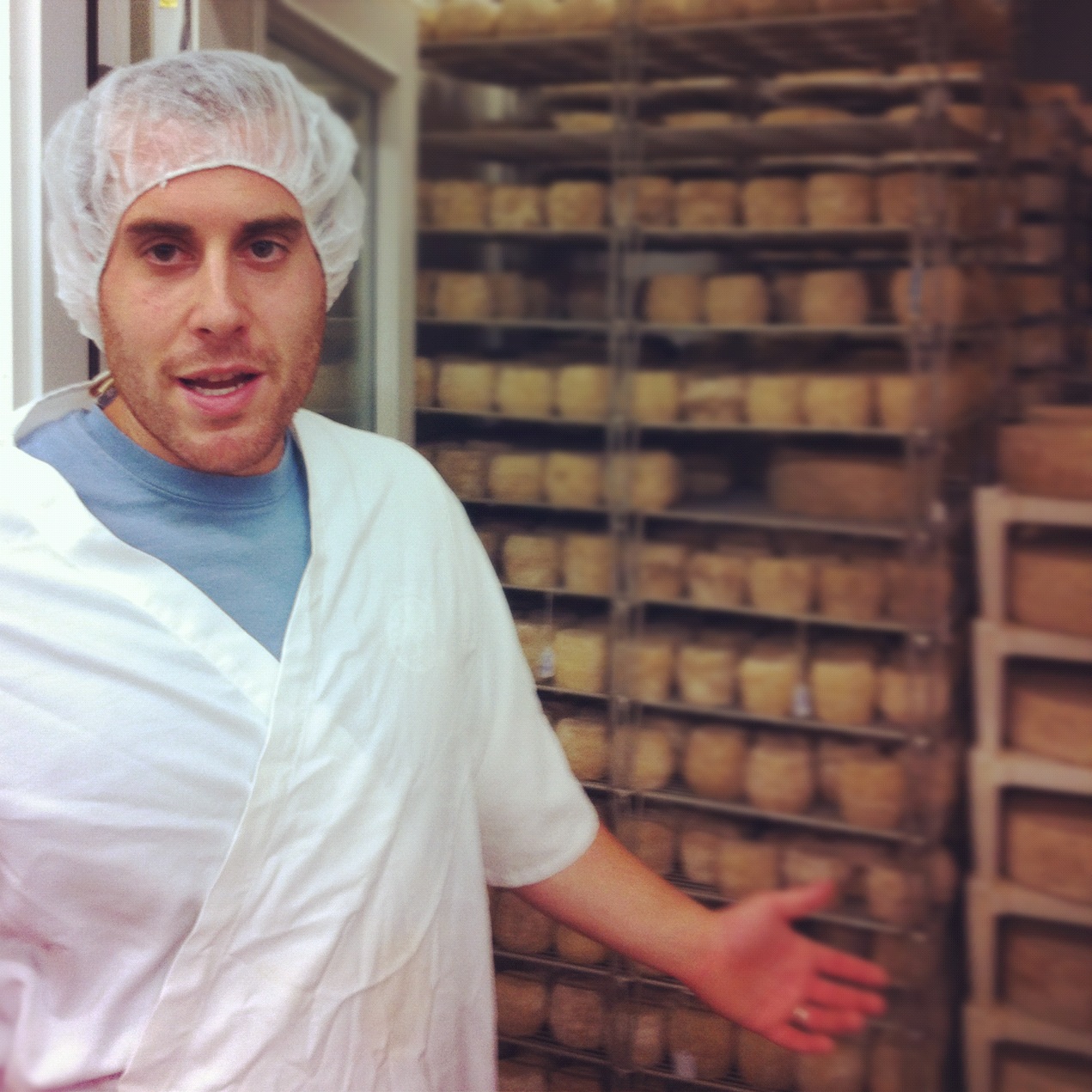
Here he is in front of one of the many aging rooms - you can see Barat on the racks on the left. The lovely Miss Audrey was our guide for the rest of the tour.
Cheese in the salt bath. Each of the cheeses is given a bath before it enters the aging area. The cheese-making facility produces both cow and goat milk cheeses, and each is placed in its own aging room.
Some of the finished product in the case, in the (beautiful) market. Along with cheeses, they had produce from the farm and other local delicacies.
Yearlings had just been added to the herd and the goats were nervous. The farmers milk around 18-20 of the herd of 60 goats every day. I also saw the area where the cows and goats were milked, but we were too late for the morning milking.
A closer look at the Barat aging on the racks. Colin makes about 8 - 10 aged cheeses. They also sell fresh goat cheeses and fresh ricotta.
The farm also sports chickens, ducks, Guinea fowl, pigs, sheep, and cats. These are mostly used as teaching tools for the many school groups that visit throughout the year.
The Park Slope Food Coop cheese department is currently selling Toussaint, a raw cow's milk cheese with a distinctive Alpine flavor and a smooth tight texture. We'll be carrying more of Sprout Creek Farm's cheeses in the fall.
I highly recommend a visit if you're in the area. There are cabins to rent, and even just a walk around the Platonic ideal of a farm is refreshing and gives you hope for the new generation.
Tuesday, July 31, 2012
Friday, July 27, 2012
New Seggiano products
Warm welcome to the Seggiano line of products now available on the rear end-cap across from the chicken case.
- Raw Basil Pesto Genovese
- Ligurian Red Pesto
- Roasted Garlic Cloves
- Oven Roasted Cherry Tomatoes
- Tuscan Extra Virgin Olives Oil
- Organic IGP Balsamic Vinegar of Modena
Friday, July 20, 2012
Apple Forecast
Organic
- Fuji - September 17th
- Gala - August 23rd
- Granny Smith - September 24th
- Pink Lady - October 22nd
- Red Delicious - September 10th
- Cameo - October 18th
- Cortland - August 31st
- Empire - September 14th
- Fuji - October 18th
- Gala - August 9th
- Ginger Gold - July 30th
- Gold Delicious - October 1st
- Honeycrisp - August 20th
- Jonagold - September 14th
- Jonamac - August 30th
- Macoun - September 20th
- McIntosh - August 23rd
- Mutsu - October 3rd
- Pink Lady - October 24th
- Stayman - October 3rd
Produce notes from Allen....121 Local Items!
Here is a forecast for new items from Hepworth Farms, coming soon to a coop near you. Beginning Friday
7/20 we are offering two new Tomatoes, both in 20 oz. clamshells. One
is the "Mountain Magic" which may be compared to Campari or other
cocktail Tomatoes. Sarah Z says "they are the best Tomato ever". The other offering contains a selection of mini Heirlooms. On Tuesday
7/24 we expect the first of this year's Hard Neck Garlic and Sweet Frying Peppers. Soon after we will receive Celery, other Peppers, and
the final harvest of Apricots. Also various Heirloom Cucumbers,
including Suyo, Tasty Jade, and Striped Armenian.
We will
continue to have sporadic deliveries of Local Black and Red Raspberries
and Blackberries, but we have already seen the last of the Local Cherries. We'll see our first "out of the ordinary" Beans, coming from
Lancaster Family Farms Cooperative on 7/20, with the arrival of Lima, Rattlesnake and Yellow Romano Beans.
I was stopped by a member while I was walking home during the Wednesday
afternoon cloudburst, who asked "Where are the Apples?" I told her that
it is not yet the Apple season, and supplies from last year have been
nearly exhausted. Had it not been raining I would have added that a poor
harvest last fall led to shortages this spring and summer. The packers
who had any Apples at all in Washington state, Chile, or Argentina
understand the law of supply and demand which is, "We have all of the
supply, and we can demand whatever the ____ we want!" The prices have
been dreadful, beyond any we have ever seen or even imagined. This
weekend, one of our suppliers is getting an influx from New Zealand, and
even if the prices remain high, we may be able to buy unbagged apples,
if the prices are at least reasonable. The reason we buy organic in bags
so often is that on average the per pound price will be 20 to 30%
cheaper.
Most of us are aware that there is a
drought, as well as killing heat wave, affecting most of the United
States. Early reports are that this will result in produce shortages.
The first crop that is being severely affected is Corn, which will lead
to higher energy costs, higher costs on all Corn sweetened junk and corn
fed meats. In other words, this will affect the cost of just about
everything. It looks like our local growers of organic and "integrated
pest management" (IPM) Corn are OK. By the way, none of the Corn that we
carry is genetically modified. We are committed to not buying
genetically modified fresh fruits and vegetables.
Here are a couple of quotes from local farmers concerning the drought. "I don't have much of anything to send. The
drought and heat are taking a toll", said Robin Ostfeld of Blue Heron
Farm near the Finger Lakes. She in fact was unable to offer us any
produce at all this week. Hepworth Farms in Milton, NY expected rain on Wednesday. "There wasn't much rain, just enough to let the dust settle and make
the weeds grow, but not enough to help", said Amy Hepworth.
LATE BREAKING NEWS!!
Our supplier expecting the influx of New Zealand apples is not receiving the amounts we hoped for. So Fuji from Chili is all we will be offering until further notice.
Despite all of their hardships, our local farmers came through for us with 121 local items this week.
Allen Zimmerman - Produce Buyer - General Coordinator
Tour of Brooklyn Brine
So, yesterday I heard that Brooklyn Brine had moved their facility into our backyard - 4th and President St. - so I thought I'd take a ride over and see what's going on. Seamus Jones, the brineologist, was gone for the day so I chatted with Roxanne as she stuffed beets into jars. Everything is still done by hand right there in the small warehouse.
Pickles fresh from the water bath left to cool. All of the cucumbers are locally sourced (hence the great push to get things in jars right now).
You can pick up your favorite pickles right there . . . plus some in store only specials. There was maple bourbon pickle relish while I was there. Looked great.
Maple Bourbon pickles waiting for the brine.
So yeah, Brooklyn Brine pickles are available here on the rear endcap across from the chicken or go check out the store/brinery on President between 3rd and 4th.
Pickles fresh from the water bath left to cool. All of the cucumbers are locally sourced (hence the great push to get things in jars right now).
You can pick up your favorite pickles right there . . . plus some in store only specials. There was maple bourbon pickle relish while I was there. Looked great.
Maple Bourbon pickles waiting for the brine.
So yeah, Brooklyn Brine pickles are available here on the rear endcap across from the chicken or go check out the store/brinery on President between 3rd and 4th.
Thursday, July 19, 2012
Wednesday, July 18, 2012
All about Flora Nelle
Culture Cheese article on Flora Nelle, now at the Coop $14.52/Lb - get some while you can!
When you first meet her, you will be charmed by Flora Nelle’s many-hued natural rind and Jersey cream–colored paste evenly freckled with tiny caves of blue. Further inspection by nose and palate will tell you that, while this cheese may be young, it’s no ingenue.
Monday, July 09, 2012
This week Barber's Cheddar is on sale for the amazing low, low price of $5.51/Lb. Don't miss out on this classic Farmhouse Cheese from Somerset in the U.K.
Friday, July 06, 2012
Roquefort from Le Meunier
Tuesday, July 03, 2012
SkyIce Sweet and Savory
Quick, what do these make you think of:
Thai Ice Tea. Black Sesame Seaweed. Cucumber Lime.
If you answered "appetizers at my favorite Thai restaurant," you are close but the real answer is so much better than that. People, these are frozen desserts! From a local restaurant, SkyIce! Thai Tea Ice Cream! Black Sesame Seaweed Ice Cream. Cucumber Lime Sorbet! These are AMAZING. Seriously. Raspberry Cilantro. What!?!
Thai Tea Ice Cream is possibly the best thing we've ever tasted. And we're not young.
Go to our ice cream case and buy some right now. You won't regret it. Did we mention the Thai Tea Ice Cream???
Thai Ice Tea. Black Sesame Seaweed. Cucumber Lime.
If you answered "appetizers at my favorite Thai restaurant," you are close but the real answer is so much better than that. People, these are frozen desserts! From a local restaurant, SkyIce! Thai Tea Ice Cream! Black Sesame Seaweed Ice Cream. Cucumber Lime Sorbet! These are AMAZING. Seriously. Raspberry Cilantro. What!?!
Thai Tea Ice Cream is possibly the best thing we've ever tasted. And we're not young.
Go to our ice cream case and buy some right now. You won't regret it. Did we mention the Thai Tea Ice Cream???
Local... Organic... Flash-Frozen... Edamame? Gimme!
For several years members have been requesting organic frozen edamame. For years we have not been able to find any from a reliably organic source. Until NOW. All that has changed. A new company called Hudson Valley Harvest features food from a collection of sustainable, small-scale farms in New York state. So now we finally have edamame (in the pods) that is local and organic. It's almost too good to be true! We're so excited! You should be too! In addition to edamame we have:
Yours,
freezer gal (with a little help from tofu girl)
- Collards
- Corn
- Squash & Zucchini Mix
Yours,
freezer gal (with a little help from tofu girl)
Raw Organic Coconut Water
Harmless Harvest Coconut Water is here.
- Refrigerated (in the milk/juice cooler at the end of the Produce aisle)
- 8 ounce and 16 ounce sizes (when available)
- Delivered to the Coop 5 days a week.
- Owner is a PSFC member
- Nifty website where you can learn more about the company and it's ambitions.
- Already absurdly popular so we don't need to say anything more.
Friday, June 29, 2012
Today we have 107 local items. Instead of a steadily increasing number of local items, we find our selves with fewer. Although fluctuations are not surprising, we do know that our menu is diminished by the recent short heat wave and the one that hits us today will have devastating effects. While most of the US is already experiencing record high temperatures for the month of June, we have only slightly been affected so far. Even only two or three days of high heat last week ended our local strawberries and hurt our local raspberries. I feel for the farmers and farm workers who work so many hours in this heat. Amy Hepworth told us today that she pulls the workers out of the fields during the higher mid-day temperatures.
From coast to coast, crops in general will suffer. If there is enough and not too much rain, (not enough is likeliest), some crops will probably fare pretty well. Peaches and other stone fruit and local watermelons come to mind. Other crops may get a slightly earlier start to their season; most crops have started about when we have expected them so far this year. We have been enjoying local tomatoes for the last few weeks, but we don't have higher temperatures to thank for them.
So far we have enjoyed heirloom tomatoes from Farmdale Organics and Riverview Organics, members of Lancaster Family Farm Cooperative of Lancaster County, Pennsylvania. We have enjoyed red tomatoes from Plum Hill Organics, also of Lancaster, and from Hepworth Farms in Milton, New York. We have not had this early start of the local tomato season because of the high heat, though. They were planted earlier than would ordinarily be considered safe from late spring cold temperatures, protected from the weather by various temporary shelters. They include high tunnels, cold frames, hot beds and other housings. These tomatoes come with a high materials cost, and greater labor overhead, are very expensive, but many members have told me that they were worth it.
Most folks know by now never to refrigerate tomatoes. Tomatoes produce a flavor enzyme as it ripens.When tomatoes are stored below 55 degrees the enzyme stops producing flavor (permanently). The longer the tomato is stored in the cold the more the flavor will degrade. The water inside a cold tomato may expand, causing individual cells of the tomatoes to burst. The tomato may still look good but will be mealy when you bite it. I remember hating most of the tomatoes from California that I ate, and how boring they were compared to New York and New Jersey tomatoes. When visiting farms in California several years ago, I ate a California tomato straight from the field (close your eyes Amy Hepworth), and it may have been one of the best tomatoes I have ever eaten.
I learned today from the New York Times, that there is another factor that has contributed to crummy tasting tomatoes. About 70 years ago a chance gene mutation, (not engineered by humans, but naturally occurring), was discovered. Breeders found that tomatoes with this gene ripened uniformly scarlet when ripe, and they bred this quality into nearly all tomatoes. Researchers have now discovered that the gene that was inactivated by that mutation was the gene involved producing the sugar and aroma of a great tomato. Now that this mutation has been bred into most modern tomatoes, it is hard to find great tasting tomatoes. The best way to find great tasting tomatoes is to buy the varieties that were around before the introduction of the new breed of tomatoes, the many heirloom varieties. I was always happy to provide these tomatoes, happy that they taste so good and are so pleasing to the eye. I was happy to support biodiversity and the preservation of species (yes, the best way to preserve them is to eat them, causing greater demand for them), and now we know a bit more about them and why they taste so good. Here is a link to the varieties of heirlooms grown by Amy Hepworth:
Allen Zimmerman
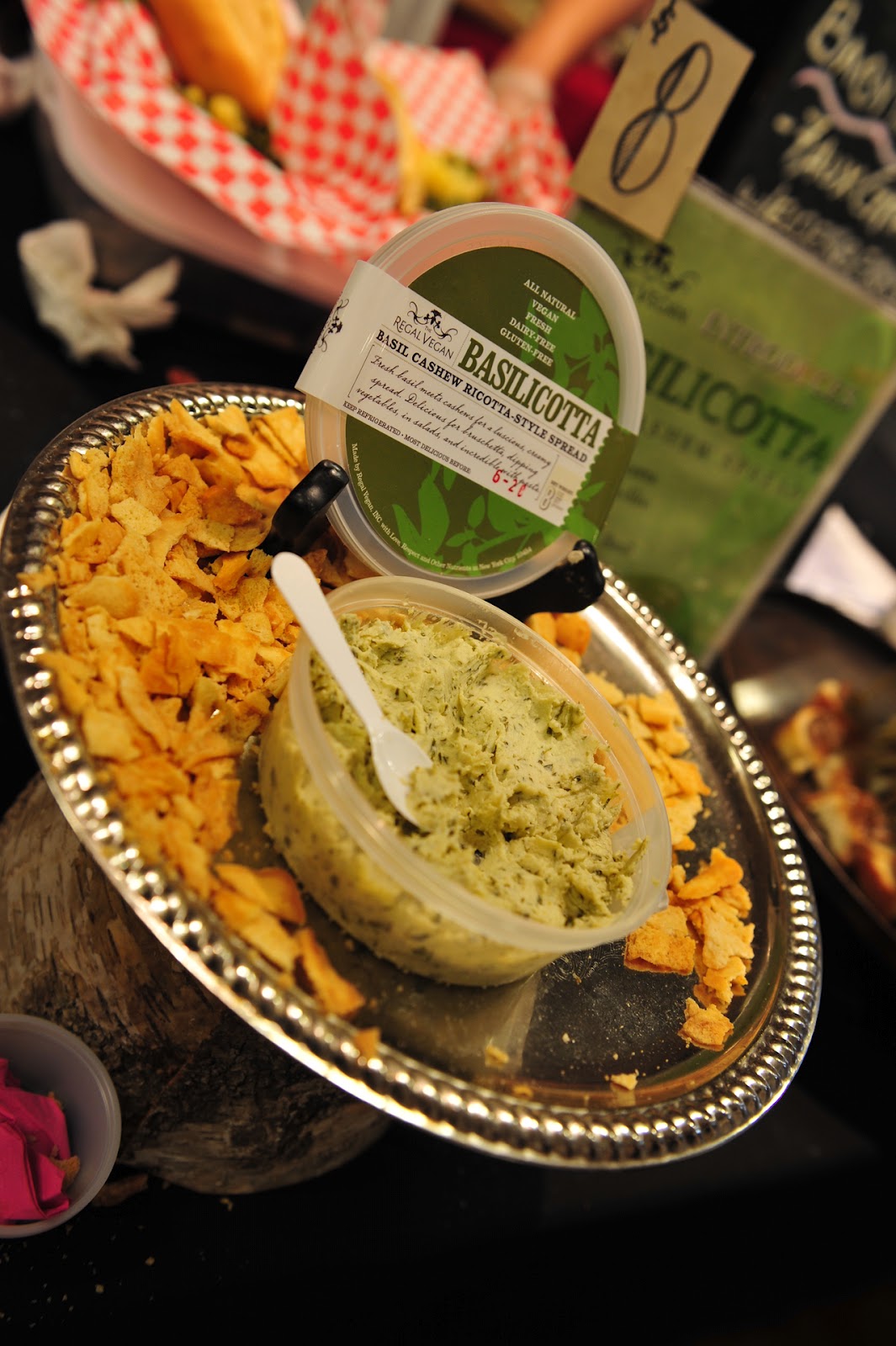
Welcome to The Regal Vegan's Basilcotta, a beautiful mixture of cashews and fresh basil. A welcome addition to our vegan cheese selection. Only $6.05!
Friday, June 22, 2012
Our menu is changing fast. This week we saw more apples disappear, organic granny smith and red delicious. Minimally treated local golden delicious and stayman winesap ended. The first new apples of the year will come late in the summer. Florida valencia oranges ended, but California valencia finally tastes good. The heat wave may have ended the local strawberries, but local raspberries are in stronger supply. Local black raspberries are trickling in.
Organic shallot supplies of last year's harvest are finally exhausted and freshly dug, not yet cured (outer skin allowed to dry), beautiful new shallots are available. Find them next to spring onions, below the cabbages. This Monday we may get our last of the season NYS asparagus, as the North American harvest is ending.
The biggest changes to our menu this week involve the items that are now all locally sourced. They include all blueberries, red and white minimally treated cherries, green and purple basil, fava and green beans, red, chioggia and bunched beets, nappa, green and savoy cabbage. Also bunched carrots, purple cauliflower, fresh garlic stalks, flower power local salad, purple scallions, squash blossoms and all of the summer squashes are local. They include cousa or magda, patty pans, roly poly, green, yellow and striped zucchini, yellow straightneck and crookneck squash. We have our earliest arrival of local tomatoes, red and heirloom, all hothouse grown. Coming soon are local pluots, sour cherries and starting on Monday are the first local corn of the year. Next week we will try sugar baby watermelons with seeds from Lady Moon Farms in Georgia. This week we had very good seedless watermelons from the southern desert climate of California, which prompted members to ask once again. "What's up with seedless fruit?"
There is a very big difference between traditional breeding and genetic modification. Natural reproduction or traditional cultivation occur within the boundaries of nature between very closely related species. Dogs may mate with dogs, but not with cats. Pollen from a zucchini may fertilize a yellow squash, but not a pepper. Genetic engineering crosses genes between unrelated species that would never occur in nature, such as splicing an arctic flounder gene in tomatoes to allow the tomato to withstand cold. Organic fruits and vegetables cannot be raised using genetic modification and we will not buy non-organic produce that might have been genetically modified. Seedlessness and genetic modification have nothing to do with each other.
There is evidence that Persians 6,00 years ago were very involved in developing seedless grapes. They were not the first, and in fact humans have been carefully breeding plants to get desired results since the dawn of agriculture, long before recorded history. Small seeds or larger fruits were among the traits that they sought to reproduce. Seedless oranges and seedless grapes are the result of cultivating naturally occurring seedless plants. A tree found on a plantation in Brazil in the 19th century spontaneously changed (mutated), and produced seedless oranges. From this single tree, every single navel orange tree has descended. You may well wonder how seedless trees reproduce. or more accurately, are reproduced.
A branch of a desired fruit is grafted onto a different tree (or in the case of grapes, a vine), and fruits from that branch will produce the desired fruit. Some trees or vines will provide sturdier, healthier roots, but not the most desirable fruits. To this "rootstock" desirable fruits will be grafted.
I will leave you with some facts of life in agriculture and write more about them in coming weeks. An apple seed will not reproduce the apple that it came from. A red delicious seed will not produce a red delicious apple. but rather a random new and previously unknown apple. All apples are grown using splicing and grafting techniques. All citrus seeds may produce citrus fruits, but not necessarily the same fruit that it came from. There has been so much grafting and crossing of varieties, that any of the many fruits that contributed to the makeup of the current tree, may be reproduced from the seeds of that tree.
In weeks to come I will write about more aspects of seedlessness.
This week we have 118 local items
Allen Zimmerman
Friday, June 15, 2012
We are often asked what days produce is delivered or which day do we get organic delivered? We get produce, most of which is organic, delivered 6 days a week. In fact, we received 34 produce deliveries this week. For the past three weeks we received an average of 6200 cases of produce per week.
We currently have 112 local items. Much of what we don't identify as local, is local, but unless it is 100% local, we simply label it as from USA. As each new item's season begins, we are unable to get as much as we wish we could from our small family farms. Sometimes you will be able to select the ones you prefer by reading the label on the box. For example, this week we continued to offer tomatoes from Mexico, but you will also find the first offerings of Hepworth Farms, NY and Lancaster Family Farms Cooperative, Pennsylvania. Our next new local arrivals will be on Monday, when we will receive tarragon, baby squash with blossoms, organic kirby cucumbers, black raspberries, red romaine, and loose spinach.
Next week, I will be writing about "seedlessness", as members wonder how seedless fruit works. Is it irradiated, is it genetically modified, is it a hybrid, how do they make babies, how can it be organic, why don't we have grapes with seeds? One brief point this week, and more to follow next week. Persians developed the seedless grape 6,003 years ago. I know that they were not genetically modified because the Persians lacked the electricity to plug in their electron microscopes. 6003? Well 3 years ago I learned that the Persians had developed the seedless grapes 6,000 years ago.
The following are the percentage of each type of grape eaten in the US for the 52 week period ending 3/31/12:
57.3% red seedless
35.8% green seedless
5.6% black seedless
1.4% all other grapes (This category contains all varieties of grapes with seeds.)
Tuesday, June 05, 2012
Fedco Seed Sale!
Seed sales have tapered off, but now while it is rainy and warm, is the time to plant many of the later veggies. Come buy carrots, cucumbers, melons, swiss chard, beans, collards, squash. Also but seeds for fall planting! FEDCO seeds are now 25% of the price marked on the packet.
Saturday, May 26, 2012
Produce notes from Allen.....80 local items!
I had a request from a member that I would like to share with you. She asked me to please stop members from doing horrible thing to the fruits and vegetables. I agree with her sentiment and hereby ask you (and to ask you to ask everyone else) to stop doing these horrible things:
- Dumping Apples out of boxes instead of hand placing them.
- Removing fruits from the protective trays in which they are delivered
- Making mounds of Bananas.
- Peeling Corn and leaving the now worthless Corn behind.
- Leaving Carrot greens or Fennel fronds on the shelf.
- Mixing Sugar Snap Peas with Peas in the Pod.
- Breaking off Portobello stems (don't kid yourself-this is stealing)
- Breaking off Asparagus "butts" (don't kid yourself-this is stealing)
- Tearing off Leek greens (don't kid yourself-this is stealing)
It is very difficult for workers in the produce aisle, with little or no experience or supervision, to make the right decisions concerning produce handing or even where to place the approximately 250 different items we carry. We have a tool which very few workers are aware of, one which will help guide you with necessary fundamentals of produce handling. There is a green flyer in a rack to the right of the Mushrooms, entitled "An Introduction to Working in the Produce Aisle". Please take a few minutes to read this before you start your work.
Here are a few interesting numbers for the two week period that ended 5/20:
- 8,324 pound cups of organic Strawberries (By the way, the first few local Strawberries arrived 5/22 and 5/25. We only received 384 pints this week and look forward to higher numbers next week)
- 7,172 pounds of organic Mineola Tangelos (whose season may be ending)
- 7,498 pounds of Avocados
- 22,325 pounds of Bananas
- 4,333 pounds of Mangos
- 1,152 Pineapples
- 5,592 bunches of various Kale
- 9,742 pounds of Carrots
Today we have 80 local items.
Allen Zimmerman - Produce Buyer - General Coordinator
Friday, May 11, 2012
Hottest fudge on the shelf!
We are now carrying Emack & Bolio's delicious Hot Fudge!
Before Ben & Jerry ever scooped a cone, Boston based Emack & Bolio's was serving up the most exciting flavors in a town known for it's ice cream. The company is family owned and run with the same commitment to social responsibility and creativity that it was founded on. It's made in Charlestown, Massachusetts and packaged in Maine.
Produce Notes from Allen....74 local items!!
Keep your questions coming! Here are some of the questions asked this week.
"I
found Rhubarb on a list of vegetables that have the least amount of
pesticides used on them. Why do we only have organic? The organic are
more expensive and sometimes there are none."
You
will find Strawberries on the list of fruits that have the most
pesticides used on them. We try to buy only organic Strawberries for
that reason. It doesn't make sense to me to have one item organic, and
one not, when they are so often used in combination. Many members are
familiar with lists of what to only buy organic, or what may be
relatively safe to not buy organic. Many members do not, or will never
buy produce unless it is organic. We hope that this decision serves most
members well. At this point in the season, the supplies are increasing,
and now that most of our Rhubarb is local, we are starting to see lower
prices as well.
"I
cut open a Melon and it was green inside. I was upset that it wasn't
orange, because I wanted vitamin A. What happened to my Melon?"
This
member bought a Galia Melon, which slightly resembles a Cantaloupe. It
is green on the inside, a color which wouldn't surprise a Honeydew
eater. (Although we occasionally carry orange flesh Honeydews.) She
wanted me to warn people what color fruits are on the inside, and I
replied that I could not do that, although we do identify all Watermelon
by color. If you are concerned about the color of each fruit, google
them before you shop. You can find our daily produce selection updated Monday through Friday at: click here
As
far as the vitamins go, I leave that up to you. I am the produce buyer,
not the vitamin buyer. I think that you can't go very wrong when you
eat any fruit in place of another. By the way, galias are very high in
Vitamin A. She did say that it was delicious, and you can find out for
yourself when they return to our shelves next Friday.
"How
can hydroponic produce also be organic? I know that stuff is added to
the water. How can you add stuff to the water and still claim that the
produce is organic?"
It is not the coop that makes the claim that something is
organic. A farmer or producer may make that claim after they have been
inspected and certified by an independent party (such as CCOF or NOFA).
All produce sold as organic at the coop has been certified by
an independent party. Many nutrients, fertilizers and various chemicals
may be added to the water for hydroponically grown organic produce. Many
nutrients, fertilizers and various chemicals may be added to the soil
for field grown or hot house grown soil based organic produce. The
National List of Allowed and Prohibited Substances may be seen at: click here Organic
doesn't mean "free of chemicals". Anything added to the soil or water
must be considered benign, safe for consumption, and will be described
in the USDA National Organic Program.
"How can I know which produce items are locally grown?"
We
only identify items as locally grown when 100% of that item is sourced
locally. For the last few weeks, a great deal of the Lettuces and Kales
were locally grown, but we were not able to supply all of our needs for
the item locally. Now that we are starting to have access to more and
more local produce, there are three easy ways to identify the source of
each item.
Go to our daily menu (click here)
and click on the column "Origin". The origin of each item is also on
the shelf price sign of each item. If you would like to see all of the local
items at a glance, see the green highlighted lists, updated Monday through Friday, at the front and rear of the produce aisle.
Allen Zimmerman - Produce Buyer - General Coordinator
Subscribe to:
Posts (Atom)